
The Chartered Institute of Ecology and Environmental Management (CIEEM), an SER-Europe affiliated organisation representing ecologists and environmental managers across the UK and Ireland, has published a growing body of good practice guidance for ecological restoration. The Rebuilding Nature series provides practitioners, students, and land managers with a structured, evidence-based framework for delivering restoration across the terrestrial, freshwater, and marine environments of the UK and Ireland.
How the series developed
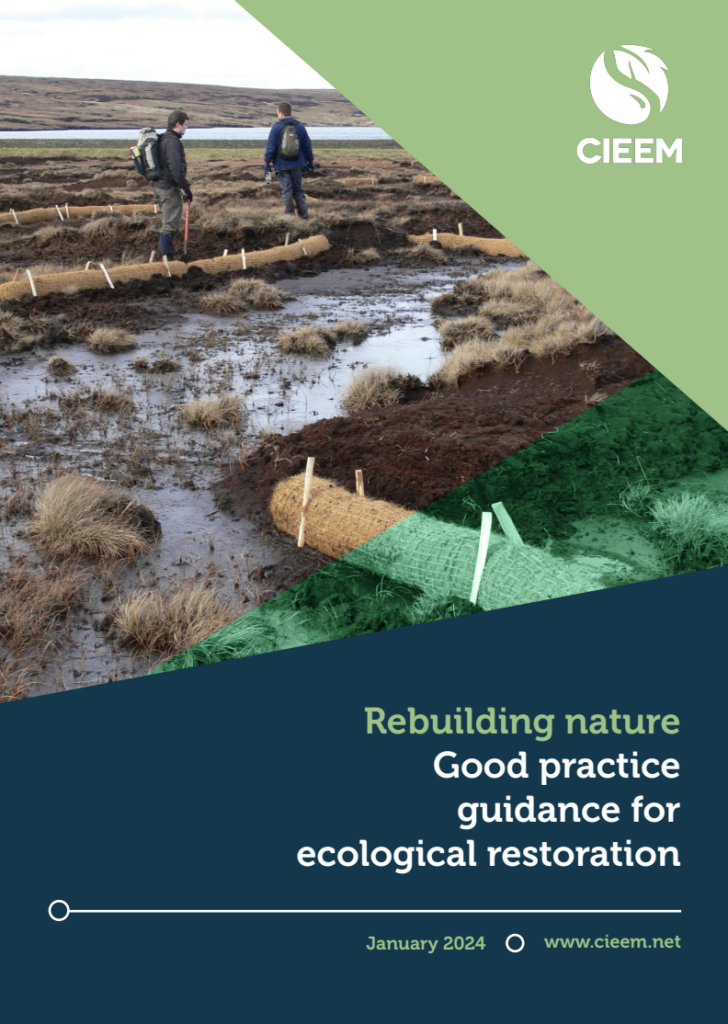
The series began in January 2024 when CIEEM’s Ecological Restoration Special Interest Group (ERSIG), published an interim document setting out ten good practice principles for ecological restoration, based on the SER Principles and Standards, accompanied by a glossary and a reference list of approximately 130 habitat restoration sources. That interim document formed the foundation for the full series now being published in stages through 2025 and 2026.
CIEEM subsequently published five Overarching Topic documents, each written by experts in ecological restoration from the UK and Ireland. These apply to any restoration project in the UK and Ireland regardless of habitat type or scale, and cover: Project Planning and Implementation; Integrating Ecosystem Services into Ecological Restoration; Physical Environment; Large-Scale Nature Recovery and Restoration; and Monitoring.
What the guidance covers
The Overarching Topics provide a cross-cutting framework that practitioners can apply before moving into habitat-specific guidance.
- The Project Planning and Implementation topic sets out a staged approach to objective-setting, design, consents, and long-term management, with emphasis on SMART objectives and stakeholder engagement from the outset.
- The Ecosystem Services topic demonstrates how restoration can deliver multiple benefits simultaneously, including flood management, carbon storage, clean air, and human health and wellbeing, rather than addressing these as secondary considerations.
- The Physical Environment topic takes a systems thinking approach, showing how geology, soils, hydrology, and ecological characteristics are interdependent and must be understood together for restoration to succeed.
- The Large-Scale Nature Recovery and Restoration topic connects site-level practice to the global ambition of achieving a Nature Positive world by 2030, as set out in the Kunming-Montreal Global Biodiversity Framework (KM-GBF), and to National Biodiversity Strategies and Action Plans being developed across the UK and Ireland.
- The Monitoring topic treats monitoring as integral to project design from the very start, not as an afterthought added once works are complete. It defines monitoring as the systematic process of collecting, analysing, and using information to track a project’s progress towards its objectives and to guide management decisions, and stresses that monitoring must be built into the project and budget from the outset, be simple, affordable, and repeatable, and rest on a good baseline survey. The guidance also highlights a practical benefit: projects with a well-designed and effectively implemented monitoring framework are more transparent and find it easier to account for their actions and expenditure to funders, local communities, and other stakeholders.
Habitat-specific guidance has been published to date for three of the UK and Ireland’s most ecologically significant and threatened habitats: bogs, heathlands, and hedgerows. Further documents covering woodland, grassland, scrub, and other habitats are due through 2026.
Why this is of interest to the SER-Europe members
CIEEM positions the Rebuilding Nature series as good practice guidance for the UK and Ireland, grounded in the practice and policy context of those countries. It is of interest to the wider SER-Europe network because it draws on the same international foundations that SER-Europe members use. CIEEM’s guidance references the SER International Principles and Standards for the Practice of Ecological Restoration (SER Standards), including the Restorative Continuum, which SER-Europe uses as a core tool for understanding and communicating different levels of restorative action. The series also addresses Biodiversity Net Gain, now embedded in planning law in England, and engages with carbon markets and nature-based solutions as contexts in which clear and consistent restoration guidance is increasingly necessary.
For SER-Europe members working under the Nature Restoration Regulation (NRR) and developing National Restoration Plans, CIEEM’s series offers a useful example of how a national professional body has translated shared international principles into practical guidance for its own terrestrial, freshwater, and marine context. Each document in the series is peer-reviewed within the Ecological Restoration Special Interest Group and by members of CIEEM’s Professional Standards Committee before publication.
Looking ahead
The series is available free of charge at cieem.net and is accompanied by an ongoing programme of online events and webinars supporting each published section. Additional habitat-specific documents are expected through 2026, and CIEEM’s working group plans to develop technical competencies and standards for habitat restoration following completion of the guidance series.
The shared foundation that CIEEM’s guidance draws on is itself developing. SER is preparing the third edition of the SER Standards, expected in June 2026. Together, CIEEM’s practical national guidance and the forthcoming SER Standards illustrate how restoration practice continues to mature at both the national and international levels. SER-Europe members with an interest in good practice, practitioner training, or the science-policy interface for ecological restoration are encouraged to engage with the Rebuilding Nature series and with CIEEM directly.
CIEEM (the Chartered Institute of Ecology and Environmental Management) is a leading professional membership body representing and supporting ecologists and environmental managers in the UK, Ireland and abroad. Their Vision is of a healthy natural environment for the benefit of current and future generations.