Date and time published: 2026-11-25 08:45:00
The EU Nature Restoration Regulation (NRR) recognises an alarming decline in Europe’s native habitats, noting that over 80% of assessed habitats are in poor condition and that the regulations adopted to date have not halted this decline. In response, the NRR establishes legally binding, time-bound restoration targets across the EU, including, for marine ecosystems, measures to improve the condition of degraded habitats covering at least 30% of the area not in good condition by 2030. Member States were asked to submit their draft National Restoration Plans, covering terrestrial, coastal, and marine habitats, by 1 September 2026. The European Commission and the European Environment Agency are now reviewing the submitted plans, ahead of final plans in 2027. Attention should now be turning from setting restoration targets to delivering them effectively, and at scale.
To support that shift, SER-Europe has published the Marine Ecosystem Restoration Guidelines for European Seas (MERGES), now available open access on SER-Europe’s Zenodo repository.
Why these guidelines, and why now
Marine ecosystem restoration has been practised for many years, but outcomes have been mixed and the lessons learned often fragmented across regions and sectors. Translating decades of scientific research and practical experience into consistent, effective action requires clear and coherent guidance. MERGES offers a comprehensive framework for marine ecosystem restoration across European seas, integrating current knowledge from site-scale projects to large-scale seascape initiatives to improve design, implementation, and long-term effectiveness.
The guidelines place emphasis on both single-habitat restoration, such as seagrass beds or oyster reefs, and multi-habitat seascape restoration, the recovery of interconnected mosaics of habitats, as realistic pathways to achieve resilient, ecosystem-level outcomes at scale. This perspective aligns with the Society for Ecological Restoration’s third edition of the International Principles and Standards for the Practice of Ecological Restoration (SER Standards), which highlight the central role of ecosystem engineers and the need for standards-based approaches that bridge scientific evidence and management practice.
The central messages
Restoration is essential, but it cannot replace conservation. Active restoration is necessary to reverse historical habitat loss, but it is not a substitute for protecting intact habitats or for preventing further degradation.
Marine Ecosystem Restoration (MER) is therefore no longer optional but essential; it complements conservation and sustainable use by repairing damaged habitats, rebuilding ecosystem functions, and increasing resilience to future change,” page 14.
Effective restoration moves beyond “passive” and “active” as opposing categories. The strongest outcomes combine the reduction of pressures with site-appropriate in-field interventions, situated along the SER Restorative Continuum.
…’passive’ and ‘active’ approaches are complementary: the former creates the enabling conditions by reducing pressures, while the latter accelerates recovery and overcomes specific ecological bottlenecks such as recruitment failure or poor habitat suitability…” page 21.
Restoration must extend beyond established restoration techniques including multi-habitat seascape thinking. Recovering interconnected habitat mosaics accounts for the ecological connectivity between habitats and is identified as a strategic framework for scaling restoration to the levels required by the NRR and the Kunming-Montreal Global Biodiversity Framework.
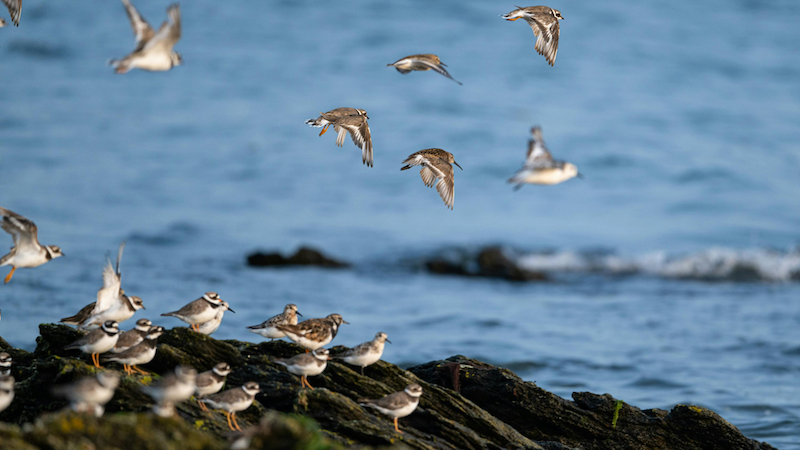
Common Ringed Plovers and Turnstones on Brittany Coastline.
Multi-habitat restoration in the marine and coastal zone, termed ‘seascape restoration’, recognises the role of structural and functional ecological connectivity between habitat patches, in enabling cross-habitat facilitative processes, increasing resilience to disturbance and positively modulating ecosystem service delivery.” page 82
Approaches must be tailored and sustained. The guidelines caution against “one size fits all” technical solutions and “plant-and-abandon” practices, emphasising site-specific design, long-term monitoring, sound governance, durable financing, and the meaningful involvement of local communities.
Practitioners must also acknowledge the fallacy of applying a ‘one size fits all’ technical solution, noting the highly site-dependent nature of restoration effectiveness…” page 125
Restoration efforts should avoid ‘plant-and-abandon’ practices: short-term projects without monitoring or maintenance frequently fail to deliver lasting outcomes.” page 127
As an overarching message, these guidelines emphasise the greater efficacy of restoration when evidence-based, site-specific, and situated within the SER Restorative Continuum… Effective MER must conceive restoration not as a single technical intervention but as a sustained process of assessment, planning, implementation, monitoring, and adaptive management…” page 128
Covering 12 marine habitat categories listed under the EU Habitats Directive and the NRR, and foundation habitats ranging from Mediterranean Posidonia oceanica meadows to cold-water coral reefs (Lophelia pertusa), MERGES provides Member States, practitioners, and policymakers with a shared, evidence-based foundation for restoration across Europe’s seas.
A collective effort
MERGES is an output of Task Force 1 of SER-Europe’s Marine Restoration Working Group, reviewed in July 2026 and approved by the SER-Europe Board. Authorship was coordinated by Roberto Danovaro (Polytechnic University of Marche) and Sahar Stevenson-Jones (SER-Europe), with a lead authorship team drawn from institutions across Europe: Marc Bouchoucha (Ifremer), Cristina Gambi (Polytechnic University of Marche), Simonetta Fraschetti (University of Naples Federico II), Stephen Hynes (University of Galway), Joel Lindholm (Under Ytan), Simon J. Pittman (University of Oxford), Pablo Sanchez-Jerez (University of Alicante), Kirsty Schneeberger (Athena Blue), and Philine zu Ermgassen (University of Edinburgh).
They were joined by 17 contributing co-authors from across the international restoration community, and the guidelines were strengthened by external review from independent specialists, including representatives of the WWF European Policy Office, the European Commission’s Directorate-General for Environment, Ifremer, and the Alfred Wegener Institute.
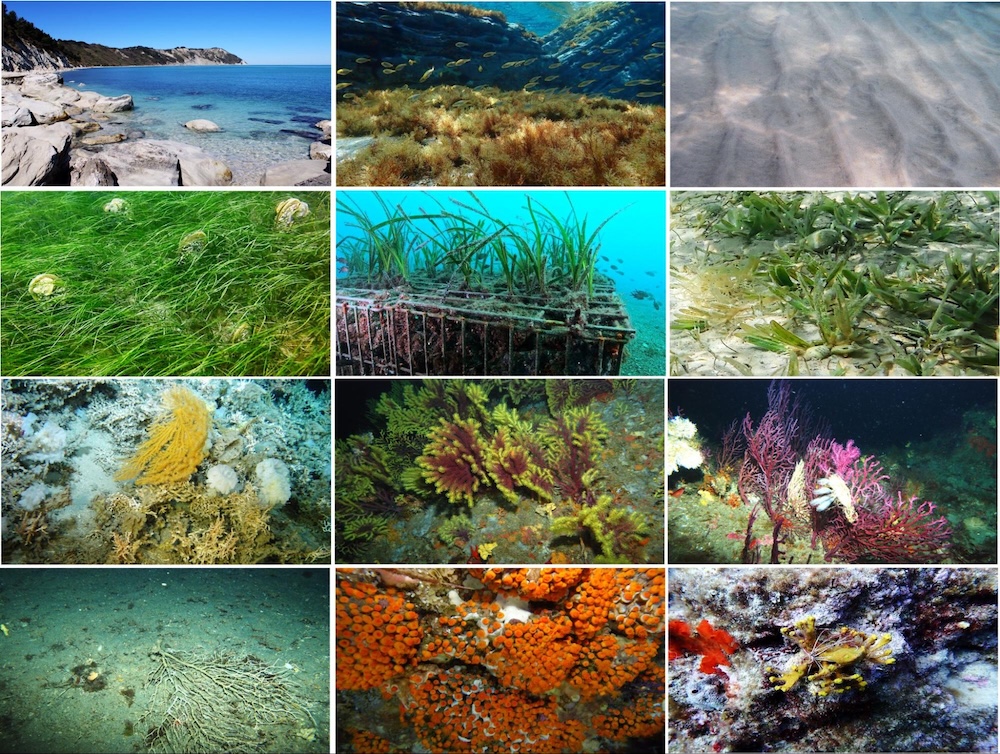
Figure 5.1 – 5.12. An example of the main marine habitats targeted for ecological restoration and included in the EU Habitats Directive. Reported are (from left to right from top to down): (first row) Habitat 1160; Habitat 1170 (macroalgal forest); Habitat 1110; (second row) seagrass bed with Pinna nobilis; Habitat 1120* Posidonia oceanica; Habitat 1110 with Halophila stipulacea; (third row) Habitat 1170 (deep-water corals); Habitat 1170 Coralligenous; Habitat 1170 Animal forest; (fourth row) Habitat 1110; Habitat 1170; Habitat 1170.
Read the guidelines
MERGES is open access and available now on SER-Europe’s Zenodo repository.
SER-Europe extends its thanks to every author, contributor, and reviewer whose expertise shaped this work.
The guidelines were produced with support from the European Commission and Interreg through the CLIMAREST, REDRESS, and REBORN projects, and represent a contribution to the UN Decade on Ecosystem Restoration (2021–2030).


This handbook supports the goals of the United Nations Decade on Ecosystem Restoration (2021-2030).